Floor slip testing on an existing floor: what the lab does on site, where to take readings, how to prepare and what the report can and can't tell you.
Umbrella Dryer Cost vs Umbrella Bags Over Five Years
An umbrella dryer costs between $990 and $1,950 at Slipless right now, depending on the size and whether it carries your logo. A single wet umbrella bagging machine starts at $495, but it needs a fresh carton of bags every few wet days for as long as it’s in the foyer. So the useful number when you look at umbrella dryer cost isn’t the price tag. It’s what each option has cost you after five wet seasons.
This article works that out for one building entrance in Sydney, Melbourne and Brisbane, using today’s prices from our store and rain day averages from the Bureau of Meteorology. The arithmetic is shown step by step, so a facility manager can swap in their own visitor count and get a figure for their own door.
What each option costs to buy
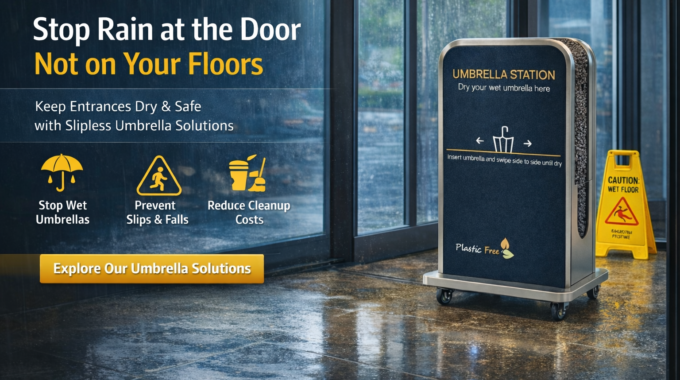
The wet umbrella dryer range runs from the Junior at $990 to the full size Eco Wet Umbrella Dryer at $1,670. In between sit the Slimline Half at $1,090 and the stainless steel Slimline Large at $1,375. Branded versions of each cost $1,145 to $1,950. They work mechanically, and the full size and Slimline Half product pages state that no electricity is needed. The umbrella is swiped through microfibre pads that soak up the water, and the product page for the Slimline Large stainless steel dryer says the pads are removable, washable and last up to five years.
On the bag side, the cheapest unit is the single chute ABS bagging machine at $495, which currently ships loaded with a free carton of 1,000 long biodegradable bags. Stainless steel single chute machines are $685, and dual chute machines run from $735 to $985. Refills from the wet umbrella bags range are $96 per 1,000 for short bags and $98 per 1,000 for long ones.
The bag machine is $880 cheaper than the Slimline Large on the day it arrives. Everything after that depends on how many umbrellas come through your door and how often it rains where you are.
The assumptions behind the five-year figures
We’ve kept the example plain so you can see where each number comes from:
- 168 bags per wet day. That’s the worked example from our article on how many umbrella bags one entrance uses in a year: 400 people through the door, 60% carrying an umbrella, 70% of those using the machine. The method is explained there and isn’t repeated here.
- Wet days are the Bureau of Meteorology’s mean number of days a year with at least 1 mm of rain: 99.5 at Sydney Observatory Hill, 88.3 at Melbourne Olympic Park and 83.7 at Brisbane.
- Long bags at $98 a carton, bought a whole carton at a time, with the first carton free.
- The $495 ABS machine against the $1,375 Slimline Large dryer, with no pad replacement inside five years because the product page rates them for up to five.
There’s no allowance for price rises, staff time or waste collection charges. Any of those would widen the gap, since the dryer has no consumable to reprice or throw away.
Umbrella dryer cost against bags over five years
Here’s the same entrance in three cities.
| Sydney | Melbourne | Brisbane | |
|---|---|---|---|
| Wet days a year (BOM mean, 1 mm or more) | 99.5 | 88.3 | 83.7 |
| Bags used in five years | 83,580 | 74,172 | 70,308 |
| Cartons bought, after the free one | 83 | 74 | 70 |
| Bagging machine plus bags, five years | $8,629 | $7,747 | $7,355 |
| Slimline Large umbrella dryer, five years | $1,375 | $1,375 | $1,375 |
| Difference in favour of the dryer | $7,254 | $6,372 | $5,980 |
Sydney’s line, written out: 168 bags times 99.5 wet days times five years is 83,580 bags. That’s 84 cartons, less the free one, so 83 cartons at $98, which is $8,134. Add the $495 machine and you’re at $8,629.
The crossover comes early. At 168 bags a wet day, bags cost about $16.46 per wet day. The free carton covers roughly the first six wet days, and the $880 head start is gone about 54 wet days after that. Call it 60 wet days in total. In Sydney that’s around seven months of average weather, and in Melbourne about eight. Brisbane takes a little longer, eight to nine months, and the timing there depends on the season: the BOM table shows about 10 wet days in March and fewer than 4 in August and September.
Running the sum for your own entrance
You need two numbers you probably don’t have yet, and both are quick to get.
- Bags per wet day. Count umbrellas coming through on the next properly wet morning, or estimate it with the visitor method in the bags article linked above.
- Wet days a year. Look up the nearest station in the Bureau of Meteorology climate averages and read the row for mean number of days of rain of 1 mm or more.
- Multiply bags per wet day by wet days, then by five.
- Divide by 1,000 and round up to whole cartons. Take one off if the machine comes with a free carton. Multiply by the carton price and add the machine price.
- Put that next to the price of the dryer that fits your entrance.
It’s worth running the low end too. Against the $990 Junior, the $495 machine stays cheaper over five years only while total use stays under about 6,050 bags, or roughly 1,200 a year. In Melbourne weather that’s about 14 umbrellas per wet day. Against the Slimline Large the threshold is about 10,000 bags over five years, around 2,000 a year, or about 23 umbrellas per wet day in Melbourne.
Staff time and what ends up in the bin
The dollar table leaves out the work. At 168 bags a wet day, a carton of 1,000 lasts about six wet days. In Sydney that’s close to 17 refills a year, and they tend to fall due in the middle of a rainy spell, when whoever does them is also mopping the foyer. The dual chute ABS machine holds 2,000 bags per load according to its product page, which halves the refills but not the bag count. Used bags also need a bin at the way out, and that bin needs emptying on wet days.
The dryer has its own task, and it’s smaller. The water the pads pull off has to go somewhere. On the Junior it collects in a concealed 1.35 litre tank that needs tipping out, and the pads come out for washing. Our product pages don’t give a set interval for either, because it depends on the rain, so put a check on the cleaning round for wet days and adjust once you’ve seen how fast it fills.
Then there’s the waste. The Sydney example sends 83,580 bags into the waste stream over five years from one door. Whether those are recyclable or biodegradable, someone has to collect them, and the bags article covers what each label means in practice.
Neither option fixes wet shoes. Safe Work Australia lists polished, wet or greasy floors among the usual causes of slips and asks for good drainage and floors dried after cleaning. Matting and a written rain routine, like the one in our wet weather entrance plan, still matter whichever way you go.
Where bags still make sense
The dryer wins on five-year cost at most busy doors, but there are real cases for bags.
- Umbrellas that travel a long way inside. The product pages describe the dryer as getting an umbrella up to 99% dry, so a little water is still on it. If visitors carry umbrellas through carpeted lifts and up to upper floors, a sealed bag keeps the last of it off the carpet.
- Low volume entrances below the thresholds above, such as a small professional office that sees a handful of umbrellas on a wet day.
- A short tenancy. If you’re out of the building in a year, the $495 machine plus a few cartons can cost less than any dryer.
Which one suits which site
Shopping centres, hospitals, clinics and office lobbies with a few hundred people a wet morning are usually better off with a dryer. The table shows the gap there runs to thousands of dollars per entrance over five years, and a dryer creates no plastic waste. Hotels and corporate receptions can have the dryer printed with their own logo, which helps when the unit sits in plain view at the door.
Small sites with low umbrella counts, buildings with long carpeted runs from the door, and short-term fitouts are the places where a bagging machine still earns its spot. Where people stay for hours and don’t need their umbrella until they leave, neither is the obvious answer, and an umbrella stand with a drip tray may suit better. Our guide to choosing entrance equipment compares all four options side by side.
Frequently asked questions
How much does an umbrella dryer cost in Australia?
At Slipless the range runs from $990 for the Junior to $1,670 for the full size Eco Wet Umbrella Dryer, with custom branded versions from $1,145 to $1,950. There are no bags to buy afterwards, and the dryers work mechanically with microfibre pads.
Is an umbrella dryer cheaper than umbrella bags?
Over five years it usually is. For an entrance using 168 bags per wet day, our worked example puts a bagging machine plus bags at $7,355 to $8,629 across Brisbane, Melbourne and Sydney, against $1,375 for the Slimline Large dryer. At very low volumes, roughly under 1,200 umbrellas a year, the bag machine can come out ahead.
How do you use an umbrella dryer?
You put the closed, wet umbrella into the slot and swipe it through the microfibre pads as you walk past, then pull it out. The pads absorb the water, so there’s no bag to fit or throw away.
What upkeep does an umbrella dryer need?
The water the pads collect goes into a reservoir that needs emptying on wet days, and the pads are removable for washing. The Slimline Large product page rates the pads for up to five years.
Where Slipless fits
We sell both dryers and bagging machines, plus the bags, so we’ve no reason to push one over the other at a site where the sums go the other way. What we don’t sell is entrance matting, and we can’t tell you your own umbrella count without a wet morning’s tally. If you send us your daily visitor numbers and postcode through the contact page, we’ll run the five-year comparison for your entrance and tell you which bagging machine or dryer the numbers point to.
Related Posts