What P3, P4, P5 and R10 mean on a slip rating report, what Australian guidance recommends for entrances, and why the number changes when it rains.
The Wet Weather Entrance Plan: A Playbook for Hotels, Retail, Offices and Healthcare
Most buildings do not have a wet weather plan. They have a reaction: it starts raining, someone eventually notices the foyer is wet, a mop appears, a sign goes out, and everyone hopes the afternoon is drier.
A wet weather entrance plan replaces that with something you can hand to a new duty manager. It answers four questions in advance: what happens when rain starts, who does it, what equipment handles the water, and how you prove afterwards that it was done. This playbook sets out the structure, then the specific version for hotels, retail, offices, healthcare and food venues.
Think of your entrance as three zones
Water arrives in stages, and each stage has its own control.
Zone 1: outside the door
The approach, the awning line, the top of the ramp. The aim here is drainage and cover, so rain is not pooling where people step and wind is not driving water under the door. External matting or grating that scrapes the heaviest water off shoes belongs in this zone. If water is ponding outside the entry, everything you do inside is working against a losing hand.
Zone 2: the threshold
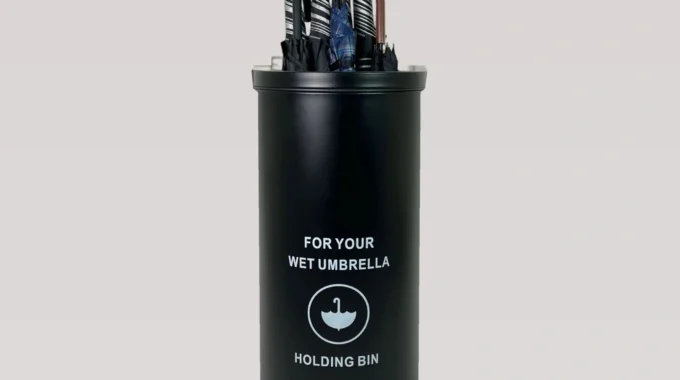
The first few metres inside, where umbrellas get shaken and closed. This is where entrance equipment goes: an umbrella dryer, a bagging machine, or an umbrella stand or bin over a drip tray. Position it on the natural walking line, inside the doors, before the first queue point. Equipment set to the side of the path gets ignored, and ignored equipment does nothing.
Zone 3: the walk off run
The matting that takes the remaining moisture off shoes. Industry matting guidance suggests roughly six metres, about fifteen feet, of walk off matting to remove the large majority of moisture and soil from a pair of shoes, so each foot contacts the mat several times. Most Australian foyers run one to two metres, which is why the wet patch continues to the lift.
The three zones are also a diagnostic. Walk your own entrance in the rain and see which zone your water is getting past. It is almost always zone 3 running short, or zone 2 missing entirely.
The rain trigger
The single highest value item in a wet weather plan is a written trigger, because it converts a judgement call into a routine.
Write it as a short sequence any staff member can follow:
- Rain starts. Nominated person for the shift is notified, or simply observes it.
- Within 10 minutes. Wet weather matting is rolled out, entrance equipment is checked and stocked, warning signs are placed on every approach to the entry zone.
- Every 20 minutes while it rains. The entry zone is inspected, standing water is removed, drip trays and bag bins are checked, and the inspection is logged with a time and a name.
- Rain stops. Inspections continue for at least an hour, because people keep arriving wet after the rain ends.
- Floor is dry. Signs come in, matting is dried or replaced, log is closed off.
The 20 minute interval is not arbitrary. WorkSafe Queensland’s cleaning guidance expects cleaning schedules to provide a rapid response to spills, to include customer and visitor areas, and to accommodate periods of bad weather. Australian slip cases have examined cleaning contracts specifying maximum intervals of around 15 to 20 minutes between inspections of common areas, so it is a defensible and well understood standard of care. Our guide to wet floor sign placement and timing covers the signage half of that routine in detail.
The duty behind the plan
Two separate obligations are in play, and buildings often think about only one of them.
Work health and safety. The primary duty of care covers workers and other persons at the workplace, which includes customers, visitors and contractors. Safe Work Australia’s slips, trips and falls guidance requires risks to be eliminated so far as is reasonably practicable, and where that is not possible, minimised. Falls, trips and slips of a person caused 32,000 serious workers’ compensation claims in 2023-24, which we break down in our guide to slips, trips and falls in Australian workplaces.
Occupier liability. If a member of the public falls in your foyer, the question becomes whether you had a reasonable system of periodic inspection and cleaning, and whether it was operating. In Strong v Woolworths Limited [2012] HCA 5, a shopper on crutches slipped on a chip in a sidewalk sales area at about 12.30pm. The area had last been inspected at 8.00am, and Woolworths accepted it had no appropriate periodic inspection system for that area. The trial judgment was $580,299.12, and after the NSW Court of Appeal overturned it on causation, the High Court allowed the appeal and set that decision aside.
The operational takeaway is simple. A signed inspection log is not paperwork. It is the evidence that the system existed and ran.
The playbook by industry
Hotels
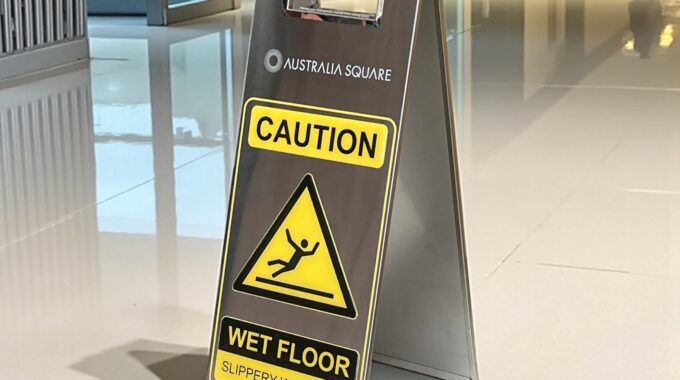
Guests arrive with luggage, often from a vehicle, and the entry is usually marble, polished stone or timber. Lobby aesthetics rule out yellow plastic, so stainless steel wet floor signage earns its cost here. Put a stand near concierge for the hotel’s own loan umbrellas, run matting from the porte cochere through to the reception desk, and brief night staff, because a 1am arrival meets the same wet floor with a fraction of the supervision.
Shopping centres and retail
Customers will not leave an umbrella at the door, so zone 2 has to keep it with them: bagging machines or dryers at every entrance, not one at the main mall entry. Watch the transition points where hard floor meets tenancy entrances, which is where the shoe changes surface and grip while still wet. Centres with food courts have a second contaminant problem on top of the rain.
Offices and corporate towers
Everything happens in two twenty minute peaks. Capacity, not speed, is the binding constraint, and the lift lobby is the danger point because that is where wet people stand still on hard floor. Stands or bins before the lift queue, matting the full run from door to lift, and a tenant communication so people know where umbrellas go.
Hospitals, clinics and aged care
The visiting population includes the people least able to absorb a fall, and lower limb injuries are a large share of serious fall claims. Keep the equipment bag free where you can, because loose plastic on a corridor floor is its own hazard. Extend the plan past the front door to lift lobbies and ward entries, and treat wheelchair and walker tracks as part of the wet zone, since wheels carry water further than shoes.
Restaurants, cafes and function venues
Small entries, no queuing space, and staff carrying plates across the same floor. A compact stand or bin in the entry alcove, short matting, and a strict clean to dry rule are usually the whole plan. The staff side matters as much as the customer side: accommodation and food services recorded 7,900 serious workers’ compensation claims in 2023-24.
Government, education and public buildings
High public volume, long dwell times, broad accessibility obligations and a documented compliance culture. This is the setting where the written trigger and the inspection log matter most, because records get requested.
Know your own wet season
An entrance plan should be seasonal, not permanent, and the season is different in each capital. Bureau of Meteorology climate averages show the pattern clearly:
- Sydney: 99.5 days a year with at least 1 mm of rain, spread across every month, with a wetter first half of the year. There is no off season.
- Brisbane: 83.1 rain days, heavily weighted to December through March. Storm season is short, intense and predictable, which suits a plan that scales up for one quarter.
- Melbourne: 88.0 rain days at Olympic Park, spread evenly, with lighter falls. Frequent light rain means the wet zone is damp far more often than it is soaked.
Build the roster around your own city’s profile. Brisbane sites should be fully stocked by late November. Sydney and Melbourne sites need a standing capability rather than a seasonal push.
The ten point checklist
- Named owner of the entrance for every shift.
- Written rain trigger, posted where staff can see it.
- Walk off matting measured in metres, not in mats.
- Entrance equipment on the natural walking line, inside the doors.
- Drip trays, water reservoirs and bag bins on a named cleaning round.
- Warning signs covering every approach, not just the front door.
- Signs removed the moment the floor is dry.
- Inspection log with time and initials, kept for at least the standard retention period for incident records.
- Visitor near misses recorded alongside staff incidents.
- Plan reviewed after the first storm of the season, while the gaps are still fresh.
Frequently asked questions
How often should a building entrance be inspected in wet weather?
Every 20 minutes while rain continues is a practical and defensible interval, with inspections continuing for at least an hour after the rain stops. Australian cleaning contracts for public areas have specified maximum intervals of around 15 minutes, and courts have examined those intervals when assessing whether a reasonable system existed.
How much entrance matting does a building need?
Industry matting guidance points to about six metres, or fifteen feet, of walk off matting so each foot strikes the mat several times. Most entrances run far less than this, which is the usual reason the wet patch reaches the lift lobby.
Who is responsible if a customer slips in our foyer?
The occupier of the premises carries a duty of care to visitors, and WHS duties extend to other persons at the workplace as well as workers. In practice the question becomes whether a reasonable system of inspection and cleaning was in place and operating at the time, which is why the log matters.
What is the first thing to fix at a wet entrance?
Whatever is missing in zone 2. If nothing captures umbrella water at the threshold, every other control is cleaning up after a problem that keeps arriving. After that, extend the matting run.
Turn it into a one page document
The plan above fits on a single page. Write the trigger, name the owner, list the equipment and pin it behind reception. Then walk the entrance during the next real downpour and adjust it, because that fifteen minutes will teach you more than any template.
Slipless supplies the equipment side across Australia, including wet umbrella dryers, bagging machines, umbrella stands and bins and stainless steel wet floor signs. Send us your entrance layout and we will tell you what belongs in each zone.
Related Posts