Three zones, a written rain trigger, a 20 minute inspection routine and a ten point checklist, plus the specific playbook for hotels, shopping centres, offices, healthcare and food venues.
Slip Ratings Explained: P3, P4, P5 and R10
A slip rating is the code on a floor test report that says how much grip a surface has when it’s wet: P3, P4, R10 and so on. Most people meet one for the first time on a tile spec sheet, or when an insurer or a new building manager asks what the lobby floor is rated.
This guide covers what the codes mean, which rating Australian guidance recommends for a commercial entrance, and why the number on the spec sheet often isn’t the number you’re walking on when it rains.
Where slip ratings come from
In Australia the ratings come from AS 4586-2013, the standard for classifying the slip resistance of new pedestrian surface materials. It sets out four test methods. Two of them turn up on almost every commercial floor report: the wet pendulum test, which gives a P rating, and the oil-wet inclining platform test, which gives an R rating. The other two cover dry floors and barefoot areas such as pool surrounds.
The P rating: wet pendulum test
The pendulum tester is a weighted arm with a small rubber pad on the end. The arm is released from a set height, the pad skids across a wetted patch of floor, and the machine records how far the arm swings through on the other side. A slippery floor barely slows it. A floor with grip takes more energy out of the swing. The result is a slip resistance value, or SRV, and the SRV decides the class.
| Class | SRV with Slider 96 | SRV with Slider 55 |
|---|---|---|
| P5 | Over 54 | Over 44 |
| P4 | 45 to 54 | 40 to 44 |
| P3 | 35 to 44 | 35 to 39 |
| P2 | 25 to 34 | 20 to 34 |
| P1 | 12 to 24 | Under 20 |
| P0 | Under 12 | Not used |
P5 is the most slip resistant and P0 the least. There are two columns because the test can be run with two different rubbers. Slider 96 is a hard rubber that stands in for a shoe sole, and it’s the one used for areas where people wear shoes. Slider 55 is softer and is used mostly for barefoot areas. A report should say which one was used. If it doesn’t, ask.
The pendulum has one practical advantage over the other test. The machine is portable, so it can be run on a floor that’s already laid as well as on a sample tile in a laboratory.
The R rating: oil-wet inclining platform test
This one is done in a laboratory. A person wearing standard test shoes walks back and forth on a panel of the flooring that has been coated with oil. The panel is tilted a little further each time until the walker reaches the limit of safe walking, and the angle at that point sets the class.
| Class | Angle reached |
|---|---|
| R9 | 6 to under 10 degrees |
| R10 | 10 to under 19 degrees |
| R11 | 19 to under 27 degrees |
| R12 | 27 to under 35 degrees |
| R13 | 35 degrees or more |
Two things to know about R ratings. The angle is a laboratory measure and has nothing to do with the slope a floor can be laid at. And the test uses oil, which is why it was written with commercial kitchens and industrial floors in mind more than a foyer on a rainy day. For an entrance the P rating is the more direct measure, and it’s the only one of the two that can be checked on site.
Is R10 the same as P3?
No. They come from different tests and one can’t be calculated from the other. What the guidance does is list a P class and an R class side by side for each type of location and accept either. P3 and R10 are paired for a lot of indoor areas, which is why people treat them as equals, but a floor that has reached one hasn’t been shown to reach the other until it’s tested.
What slip rating a commercial entrance needs
There are two sources and they do different jobs.
The building code covers stairs, landings and ramps
The National Construction Code sets slip ratings for stairs, landings and ramps only. The flat part of a lobby floor isn’t covered. These are the minimums, taken from the Australian Building Codes Board’s advisory note on slip resistance:
| Where | Dry | Wet |
|---|---|---|
| Stair tread or landing | P3 or R10 | P4 or R11 |
| Ramp between 1:20 and 1:14 | P3 or R10 | P4 or R11 |
| Ramp steeper than 1:14 | P4 or R11 | P5 or R12 |
| Nosing or landing edge strip | P3 | P4 |
The part that matters for entrances is how the note defines wet. A wet surface is one exposed to weather, or one that “on occasions, becomes wet such as in an entry lobby”. So steps or a ramp just inside your front doors are judged on the wet column even though they’re indoors.
These numbers came into the code in May 2014 and apply to new building work, so plenty of older lobbies were never tested against them.
The handbook covers everything else
For flat floors the reference is SA HB 198:2014, the Standards Australia handbook that sits alongside AS 4586. It’s guidance and has no legal force by itself, but it’s the table most slip test reports quote. Its recommendations for the areas around an entrance:
| Location | Wet pendulum | Oil-wet platform |
|---|---|---|
| External ramp steeper than 1:14 | P5 | R12 |
| External walkways, colonnades, gentler ramps and open car parks | P4 | R11 |
| Undercover car park | P3 | R10 |
| Entry or lift lobby of a hotel, office, school or public building: wet area | P3 | R10 |
| Same entry: transitional area | P2 | R9 |
| Same entry: dry area | P1 | R9 |
| Shop entry that opens to the outside | P3 | R10 |
| Hospital and aged care wards and corridors | P2 | R9 |
Read the three entry rows together. The handbook doesn’t give a lobby one number. It splits the entry into a part that gets wet, a part that sometimes does and a part that stays dry, and it asks less of the floor the further in you go. That only works if the water stays near the door.
Why a floor’s rating changes after it’s installed
Three things get between the test report and the floor you’re standing on.
The test was on new material. AS 4586 classifies new surfaces. A lobby that has had ten years of foot traffic, a few coats of sealer and a daily machine scrub is a different surface. There is a separate standard, AS 4663-2013, for measuring floors that are already in service, and it uses the same pendulum on site.
Cleaning changes grip. SafeWork NSW’s slips, trips and falls checklist asks about it twice: “Is there a build-up of polish on floors?” and “Is there an excessive residue of detergent?” Both leave a film on the surface that the original test never saw.
The dry area doesn’t stay dry. The same checklist opens its floors section with this question: “Can water be walked onto smooth floors (eg foyers) on rainy days?” The handbook’s own notes explain why it matters. They say smooth, polished floors that don’t reach P1 may be safe for people walking at a moderate pace provided they’re kept clean and dry, and that the same floors may become unsafe once they’re contaminated. Plenty of lobbies are finished in that kind of polished stone or gloss porcelain. The floor was picked for the dry row of the table. On a wet morning, umbrellas and shoes carry water well past the mats, and people end up walking on a dry-rated floor that’s wet.
What you can do about an existing floor
Replacing lobby tiles is rarely an option. These are, roughly in the order worth trying.
- Get the floor tested. A laboratory accredited by NATA for slip resistance testing can run the wet pendulum on your floor as it is today. Ask for readings at the door, at the end of the matting and at the lift lobby, because once it rains those are three different floors.
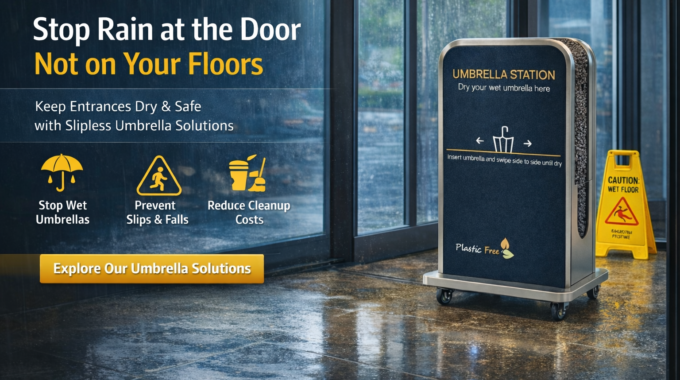
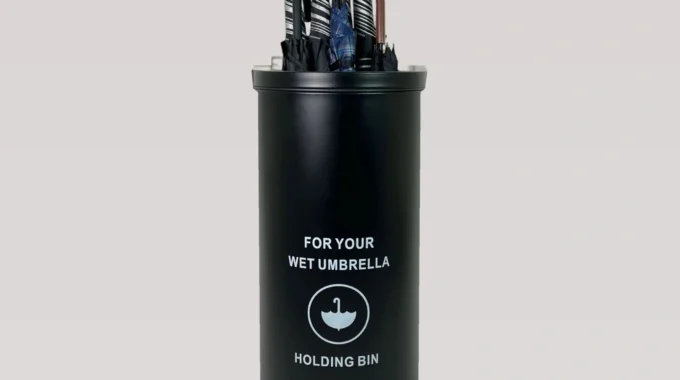
- Keep the wet area short. This is usually the cheapest change. An umbrella dryer or a wet umbrella bagging machine just inside the doors deals with the water on umbrellas before they cross the lobby, an umbrella stand with a drip tray keeps them at the door, and a longer run of matting dries shoes. The less water that gets past that point, the more of your floor is being used the way it was rated.
- Check the cleaning. Ask the contractor what goes on the floor and whether it gets rinsed off. If the floor feels slicker after the cleaners have been through, residue is the first thing to rule out, and it can be fixed without touching the tiles.
- Look at a surface treatment. Anti-slip coatings and etching treatments can lift a floor’s rating. They also change how the floor looks and how it cleans, and they wear, so have the floor tested again afterwards and book a repeat test.
- Use signs for what’s left. A wet floor sign warns people about the patch you couldn’t prevent. It doesn’t add grip. Our guide on how long a wet floor sign should stay out covers where to put them.
How to read a slip test report
- Standard and year. It should say AS 4586-2013 for a new product or AS 4663-2013 for a floor in service. Reports written to the 2004 edition use letters, and the building code treats V, W and X as P5, P4 and P3.
- Which test. Wet pendulum or oil-wet platform. For an entrance you want the pendulum.
- Which slider. Slider 96 is the one for shoes. If a lobby report quotes Slider 55, ask why.
- What was tested. A sample tile from the factory, or your floor as laid, sealed and cleaned?
- When. A report dated before the last coat of sealer describes a floor you no longer have.
- Who. Look for NATA accreditation for slip resistance testing.
Frequently asked questions
What does a P3 slip rating mean?
The floor scored between 35 and 44 on the wet pendulum test using Slider 96. SA HB 198 recommends P3 as the minimum for the wet part of an entry, for shop entries that open to the outside, and for toilets in offices, hotels and shopping centres.
What slip rating is required for a commercial entrance in Australia?
The National Construction Code sets ratings for stairs, landings and ramps only: P4 or R11 where they get wet, and P5 or R12 for wet ramps steeper than 1:14. For the flat floor, SA HB 198 recommends P3 or R10 in the wet area of an entry, P2 or R9 in the transitional area and P1 or R9 where it stays dry.
Can an existing floor be slip tested?
Yes. The wet pendulum is portable, and AS 4663-2013 covers testing floors that are already in service. The oil-wet platform test can’t be done on site because it needs a sample panel in a laboratory.
Is a higher slip rating always better?
Not indoors. Rougher finishes grip better, but they hold more dirt and take more effort to clean. That’s why the guidance asks for P5 on a steep outdoor ramp and only P1 in the dry part of a lobby.
Does a wet floor sign make up for a low slip rating?
No. A sign tells people the floor is wet. It doesn’t change how much grip the floor has. Signs cover the time it takes to get the floor dry again.
Where Slipless fits
We don’t sell flooring and we don’t test it. What we supply is the equipment that keeps the wet area of an entrance short: wet umbrella dryers, umbrella bagging machines, umbrella stands and bins and stainless steel wet floor signs. If you’re weighing those up, our comparison of stands, bins, bagging machines and dryers goes through them by building type, and the guide to slips, trips and falls in Australian workplaces has the national injury figures.
Send us a photo or a plan of your entrance and we’ll tell you what we’d put where.
Related Posts