Three zones, a written rain trigger, a 20 minute inspection routine and a ten point checklist, plus the specific playbook for hotels, shopping centres, offices, healthcare and food venues.
Wet Umbrella Bags: Biodegradable vs Recyclable, Sizes and What a Wet Season Costs
Wet umbrella bags are the cheapest item in any entrance safety budget and the only one that never stops costing money. Every rainy day, a building with a bagging machine converts visitors into bag consumption, and almost nobody works out what that number actually is before they commit to it.
This guide covers the two things buyers ask about most: which bag type to use, biodegradable or recyclable, long or short, and what a wet season really costs once you run the numbers for your own foyer.
What the bag is doing
A wet umbrella bag has one job: keep the water that is already on an umbrella from reaching your floor, your lift carpet and your stairs. The visitor pushes the umbrella into the chute of a wet umbrella bagging machine, pulls it back out inside a thin sleeve, and carries it through the building sealed.
It works because it moves the problem into a container instead of trying to dry anything. That is also its limitation. The water has not gone anywhere, and the bag itself becomes waste at the end of the trip.
Long bags or short bags?
Bag length is set by the umbrellas your visitors carry, not by your building.
- Short bags suit compact and folding umbrellas, which is most of what commuters and shoppers carry. They use less material and cost slightly less.
- Long bags suit full length and golf umbrellas, the kind that arrive at hotels, corporate receptions and anywhere people drive in and walk a short distance.
The failure mode is stocking only short bags at a site where half the umbrellas are full length. The visitor gets a bag that covers two thirds of the umbrella, and the wet third drips exactly the way it would have without a bag. If your visitor mix is genuinely split, dual chute machines exist for precisely this reason, and they hold both bag types at once.
Biodegradable or recyclable: what the words mean
These two terms get used as if they are interchangeable. They are not, and the difference matters if anyone in your organisation has to report on waste.
| Biodegradable bags | Recyclable bags | |
|---|---|---|
| What it means | The film is designed to break down after disposal rather than persisting as plastic | The material can be reprocessed, if it is collected in a stream that accepts it |
| Depends on | Disposal conditions | Whether your waste contractor actually accepts soft plastic |
| Good fit for | Sites with general waste only, and organisations reporting on plastic reduction | Sites with a genuine soft plastics collection in place |
The honest advice before you choose: ring your waste contractor and ask what they will take. Soft plastic recycling in Australia has been disrupted for several years, and a recyclable bag that goes into general waste is, in practice, landfill. If there is no collection stream, a bag designed to break down is the more useful choice. Slipless stocks both, in long and short formats.
How many bags will you actually use?
Here is the calculation, with a worked example you can copy.
Bags per wet day = visitors on a wet day, times the share carrying umbrellas, times the share who use the machine.
Take a mid size office building or clinic with 400 people through the door on a rainy day. On a genuinely wet morning, assume 60% arrive with an umbrella, and of those, 70% use the machine rather than walking past it.
- 400 visitors x 60% = 240 umbrellas
- 240 x 70% = 168 bags per wet day
Now apply the weather. Bureau of Meteorology climate averages record a mean of 99.5 days a year with at least 1 mm of rain at Sydney’s Observatory Hill, 88.0 days at Melbourne Olympic Park and 83.1 days in Brisbane. Call it 90 wet days.
- 168 bags x 90 wet days = about 15,100 bags a year, or roughly 15 cartons
At Slipless pricing at the time of writing, $96 per 1,000 for short bags and $98 per 1,000 for long bags, that is about $1,450 to $1,480 a year in bags for a single entrance. A building with three entrances is spending four to five thousand dollars a year on sleeves of plastic, before anyone has been paid to refill or empty anything.
Run the same sum with your own numbers. The variable that moves it most is the share of visitors who bother to use the machine, which is almost entirely a function of where the unit sits. A machine three metres inside the door on the natural walking line gets used. One tucked beside a pillar does not.
The costs that are not on the invoice
Refilling. Somebody has to load bags during the wettest hour of the wettest day, which is exactly when that person is needed elsewhere. Machines with larger bag capacity cost more upfront and buy back staff time.
Emptying. Used bags need a bin beside the exit, and that bin needs a round. Without one, wet bags end up on the floor, which reintroduces the slip hazard you spent money to remove.
Storage. Cartons of 1,000 bags take up space in a building where storage is already scarce.
Reporting. More organisations now have to account for single use plastics in tenders and sustainability reporting. Fifteen thousand bags a year is a number somebody may eventually ask about.
When bags are the right answer, and when they are not
Bags win where the umbrella has to stay with the visitor and the visit is short: shopping centres, supermarkets, banks, quick service venues, and any site where people would refuse to leave an umbrella at the door.
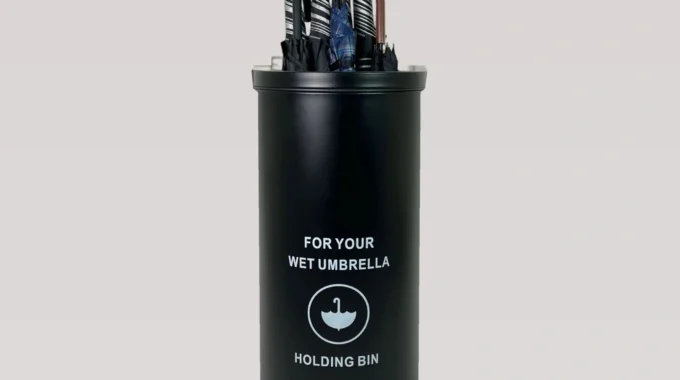
Bags lose where the visit is long or the waste is a problem. If people are staying for hours, an umbrella stand or bin with a drip tray does the same job with no consumable at all. If the umbrella has to travel with the visitor but the plastic is unwelcome, a wet umbrella dryer removes the water instead of wrapping it, with nothing to reorder. We compare all four approaches in our guide to choosing entrance equipment.
Practical operating tips
- Site the machine on the natural walking line, inside the doors and before the first queue point. Usage rate is everything in the cost model above.
- Put a labelled bin for used bags at every exit, not just the main one.
- Keep one carton at the unit and the rest in storage, so a refill takes a minute rather than a trip.
- Check bag fit against the umbrellas you actually see. Watch your entrance for ten minutes on a wet day and count full length versus folding.
- Use the machine with matting and signage, not instead of them. Wet shoes still arrive even when every umbrella is bagged.
Frequently asked questions
How many wet umbrella bags does a building use in a year?
Multiply visitors on a wet day by the share carrying umbrellas and the share who use the machine, then multiply by your local number of rain days. A single entrance with 400 wet day visitors typically lands around 15,000 bags a year in a city averaging about 90 rain days.
Are biodegradable umbrella bags better than recyclable ones?
It depends on where the bag ends up. Recyclable bags only deliver a benefit if your waste contractor collects and reprocesses soft plastics. Where there is no such stream, and general waste is the destination, a bag designed to break down after disposal is generally the more useful choice. Check with your waste contractor before deciding.
What size umbrella bags do I need?
Short bags for folding and compact umbrellas, long bags for full length and golf umbrellas. If your visitor mix is genuinely split, a dual chute machine holds both so nobody gets a bag that only covers part of the umbrella.
Can I avoid umbrella bags altogether?
Yes. Umbrella dryers remove water mechanically with no consumable, and umbrella stands and bins hold the umbrella at the door over a drip tray. Both eliminate the bag entirely, which removes the running cost, the refill task and the waste.
How much do wet umbrella bags cost?
Slipless supplies them in cartons of 1,000, priced at $96 for short bags and $98 for long bags at the time of writing, which works out at roughly ten cents per use. The larger figure is always the annual total rather than the unit price.
Next step
Run the calculation above for one entrance using your own visitor count. If the annual bag spend surprises you, it is worth comparing it against a one off piece of equipment that has no consumable.
Browse wet umbrella bags in biodegradable and recyclable formats, or ask Slipless to run the numbers with you.
Related Posts