Three zones, a written rain trigger, a 20 minute inspection routine and a ten point checklist, plus the specific playbook for hotels, shopping centres, offices, healthcare and food venues.
How Long Should a Wet Floor Sign Stay Out? Placement, Timing and the Routine Behind It
A wet floor sign is the most used safety control in Australian buildings and the most misused. It gets put out late, placed in the wrong spot, and then left standing for days after the floor has dried. By the time it matters, nobody sees it.
This guide covers the practical questions: where a wet floor sign should stand, how many you need, how long it should stay out, and what has to happen around it for the sign to do any good at all.
What a wet floor sign actually is
In safety terms, a portable wet floor sign is a hazard warning. Under AS 1319, the Australian Standard for safety signs in the occupational environment, warning signs use a yellow field with black text and symbols, which is why the standard caution sign looks the way it does. The colour is not decoration, it is the code that tells a person at a glance what class of message they are reading.
What a warning sign cannot do is remove the hazard. The UK Health and Safety Executive makes the point bluntly in its slips guidance: signs and cones only warn of a hazard, they do not prevent people from entering the area, and where the spill is not visible they are usually ignored. Australian regulators take the same position by placing warning signs in the administrative layer of the hierarchy of control, below elimination, substitution and engineering controls.
So the sign is not the safety measure. The sign is what you use while the real safety measure, drying the floor or keeping people off it, is being carried out.
Where to place a wet floor sign
Placement decides whether a sign is read or walked past. Four rules cover most situations.
- Put it in the approach, not on the puddle. A sign standing in the middle of a wet patch is discovered at the moment it is already too late. It belongs far enough back that someone can change direction or slow down.
- Cover every direction of travel. An entrance foyer is usually approached from three or four directions: the front doors, the lift lobby, the stairwell, the back of house corridor. One sign facing the front doors leaves everyone else unwarned.
- Keep it in the natural line of sight. People walking through a building look forward and slightly down, not at the skirting boards. A sign tucked against a wall behind a planter is decoration.
- Do not create a new hazard. A sign in the middle of a doorway or at the bottom of stairs becomes the obstacle people trip over. Set it beside the walking line, not across it.
For a wet weather entry, the logic changes slightly. The hazard is not one puddle, it is a moving zone that extends as far as people carry dripping umbrellas. Signs should mark the whole approach zone, and they should go out when the rain starts rather than after the first person complains.
How many signs do you need?
Count approaches, not square metres. A single spill in a corridor with two ends needs two signs. A foyer with front doors, a lift bank and a stairwell needs three. A supermarket aisle needs one at each end.
Then add one more consideration: how long is the wet area? If a person cannot see the far end of the hazard from the first sign, they will assume the hazard ended where they stopped being able to see it. Long wet zones, which is exactly what rainy day entrances produce, need signs at intervals rather than a single marker at the start.
How long should a wet floor sign stay out?
Until the floor is dry, and not one shift longer.
The failure mode here has a name in safety literature: sign fatigue, or sign blindness. When a caution sign occupies the same corner of the foyer every day for a month, people stop registering it. The next time the floor genuinely is wet, the warning carries no information, because it carried no information yesterday either.
A workable rule for a cleaning team:
- Signs go out before the mop does, not after.
- Whoever put the sign out is responsible for collecting it.
- Someone checks the floor at a set interval, for example every 30 minutes, and clears the sign as soon as the surface is dry.
- If a sign is still out at the end of a shift, it gets handed over explicitly, the same way keys are.
WorkSafe Queensland’s cleaning guidance sets the standard the sign is supporting: clean to dry, so the surface is left dry and free of moisture, and use barriers and signs to keep people off wet areas when clean to dry is not possible. The sign is the fallback, not the method.
The inspection routine behind the sign
Here is where signage stops being a housekeeping question and becomes a legal one.
In Strong v Woolworths Limited [2012] HCA 5, a woman on crutches slipped on a greasy chip in a sidewalk sales area outside a Big W store at a shopping centre. The centre’s cleaning contract specified a maximum of 15 minutes between inspections of common areas. The cleaner’s evidence was that the sidewalk sales area was inspected roughly every 20 minutes. The area where the fall happened had last been inspected at 8.00am. The fall occurred at about 12.30pm.
Woolworths accepted that it did not have an appropriate system of periodic inspection and cleaning in place for that area on the day. The trial judge awarded $580,299.12. The NSW Court of Appeal overturned it on causation, and the High Court, by majority, allowed the appeal and set that decision aside, restoring the plaintiff’s position.
The practical lesson for anyone managing a public floor is not the legal reasoning, it is the evidence trail. What the courts examined was whether a reasonable system of periodic inspection existed, how often it ran, and whether it ran that day. A business that can produce a dated inspection log at 15 or 20 minute intervals is in a very different position from one that cannot.
Signs are part of that record. If your log shows the time the hazard was found, the time signs went out, the time the floor was dry and the time the signs came in, you have documented a working system.
Choosing the right sign for the job
| Type | Best for | Watch out for |
|---|---|---|
| A-frame folding sign | General purpose, corridors, foyers, back of house | Light plastic versions blow over in a doorway draught |
| Cone sign | Wide open areas, tight spots, high traffic retail | Smaller visual target, so more units are needed |
| Cleaning in progress sign | Scheduled cleaning where staff are present | Meaningless once the cleaner has walked away |
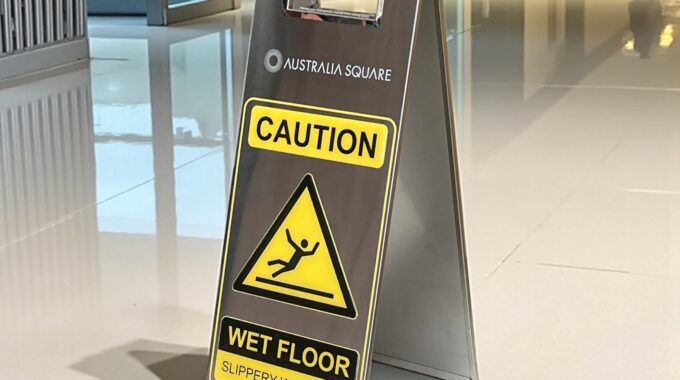
| Stainless steel signage | Hotel, corporate and premium retail foyers | Higher upfront cost, offset by not replacing it annually |
Material matters more than most buyers expect. Thin polypropylene signs crack, stain and fade, and a scuffed sign reads as a building that does not maintain itself. Slipless wet floor signs are made from 304 stainless steel, which does not rust, with yellow warning panels, a carry handle and enough weight to stay upright in the wind at a busy entrance. The range includes an A-frame wet floor sign, a three dimensional cone sign and a cleaning in progress sign, plus a black or brushed silver finish for foyers where a yellow plastic cone looks out of place.
Signs and rainy days: a different problem
A spill is a fixed hazard with a start and an end. Rain is a supply of water that keeps arriving for hours. Signs alone cannot manage that, because you cannot dry a floor that is being rewetted every thirty seconds by the next person through the door.
On wet days the sequence that works is: capture the water at the entrance, extend the matting, then use signs to cover whatever gets past those two. Equipment that takes water off umbrellas at the door, such as an umbrella dryer, a wet umbrella bagging machine or an umbrella stand with a drip tray, does the part a sign cannot do. Our guide to slips, trips and falls in Australian workplaces covers how those controls stack up against each other.
Frequently asked questions
How long should a wet floor sign stay out?
Only until the floor is dry. Leaving signs out permanently causes sign fatigue, where people stop noticing them, so the warning fails on the day it is actually needed. Build a check into the cleaning routine, for example every 30 minutes, and clear the sign as soon as the surface is dry.
Where should a wet floor sign be placed?
In the approach to the hazard, in the natural line of sight, on every side people can walk in from, and beside the walking line rather than across it. One sign facing one direction leaves the other approaches unwarned.
Do wet floor signs meet Australian standards?
AS 1319 governs safety signs in the occupational environment and defines the yellow and black format used for hazard warnings, which is why compliant wet floor signs use those colours. The sign itself is only one control. WHS duties still require you to eliminate or minimise the risk so far as is reasonably practicable.
Is a wet floor sign enough to avoid liability?
No. Australian cases look at whether a reasonable system of periodic inspection and cleaning was in place and operating. A sign with no inspection record behind it is weak evidence. A dated log showing regular inspections, when signs went out and when the floor was dry is far stronger.
How many wet floor signs does a foyer need?
Count the directions people approach from, then add extra signs if the wet area is long enough that a person cannot see the far end of it from the first sign. A typical foyer with front doors, a lift lobby and a stairwell needs at least three.
The short version
Put signs out before you start, cover every approach, keep them in the sightline, and take them in the moment the floor is dry. Log all four steps. Then spend your real effort on the controls that stop the water reaching the floor in the first place, because that is the part a sign was never able to do.
Browse the full range of stainless steel wet floor signs, or talk to Slipless about outfitting a multi entrance site.
Related Posts