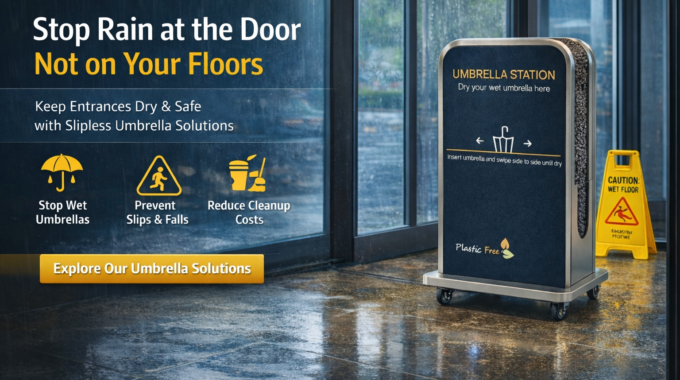
Rainy days bring a predictable problem for commercial spaces, wet floors, increased slip hazards, and…
Slips, Trips and Falls in Australian Workplaces: The Numbers, the Duty and a Wet Weather Risk Assessment
Slips, trips and falls in the workplace are not a minor category of injury in Australia. They are the second largest cause of serious workers’ compensation claims in the country, and the most common version of them is the simplest one: a person walking across a flat floor who loses traction and goes down.
This guide pulls together the most recent national data, explains what work health and safety law actually asks of a business, and gives you a wet weather risk assessment you can run at your own entrance this week.
What the latest Australian data says
Safe Work Australia’s Key Work Health and Safety Statistics Australia 2025 reports 146,700 serious workers’ compensation claims in 2023-24, which is more than 400 serious claims every day. Falls, trips and slips of a person accounted for 32,000 of them.
| Mechanism of injury | Serious claims | Share | Median time lost | Median compensation |
|---|---|---|---|---|
| Body stressing | 50,600 | 34.5% | 9.2 weeks | $19,400 |
| Falls, trips and slips of a person | 32,000 | 21.8% | 8.6 weeks | $17,800 |
| Being hit by moving objects | 23,400 | 16.0% | 5.2 weeks | $12,700 |
| Mental stress | 16,800 | 11.5% | 36.8 weeks | $69,900 |
The detail inside that 32,000 is the part most businesses miss. Falls on the same level accounted for 68.3% of those claims. Falls from a height accounted for 24.4%, and stepping, kneeling or sitting on objects made up the remaining 7.3%.
In other words, roughly 21,900 serious claims a year, about 60 every day, come from people falling over on a floor they were simply walking across. The median claim in this category costs 8.6 weeks of lost working time and $17,800 in compensation, both higher than the all-claims median of 7.4 weeks and $16,300.
One important limitation: these are workers’ compensation figures. They count your staff. They do not count the customer, patient, delivery driver or visitor who falls in your foyer, because those incidents are handled through public liability instead. For a building open to the public, the real exposure is larger than the national claims data shows.
Why same level falls dominate
A fall on the same level almost always comes down to one thing: something got between the shoe and the floor. WorkSafe Queensland’s guidance on floor and ground surfaces sets out the factors that raise the risk:
- Smooth hard surfaces increase the risk of slips, and contaminants on the floor increase it further.
- Incorrect cleaning can make floors more slippery, and a build up of cleaning product residue reduces slip resistance.
- A floor that is slip resistant when dry may not be slip resistant when wet.
- Floor roughness is more effective than slip resistant footwear at reducing slips.
- Changes in floor height of as little as 1 cm can cause trips.
That fourth point deserves a second read. Improving the walking surface does more than issuing better shoes, which is exactly what the hierarchy of control predicts. In a commercial building, the contaminant that appears most often is not oil or food waste. It is water, and most of it walks in through the front door.
How much water comes through the door
Rain in Australia is not a rare event, it is a scheduled one. Bureau of Meteorology climate averages put the mean number of days with at least 1 mm of rain at:
- Sydney (Observatory Hill): 99.5 days a year, from 1,211 mm of annual rainfall
- Melbourne (Olympic Park): 88.0 days a year, spread fairly evenly across the seasons
- Brisbane: 83.1 days a year, heavily concentrated between December and March
Call it 80 to 100 wet days a year in every east coast capital. On each of those days, every person who walks into your building carries water on their shoes, their coat and, above all, their umbrella. A closed umbrella keeps releasing water for several minutes after it comes inside, which means the wet patch is never confined to the doormat. It follows the visitor to the lift, the counter, the reception desk and the stairs.
That is the difference between a spill and a wet weather entrance. A spill is one location and one clean up. Wet weather is a continuous supply of contaminant onto your floors for as long as the rain lasts.
What the law asks of you
Under Australian WHS law, a person conducting a business or undertaking must eliminate risks to health and safety so far as is reasonably practicable, and where that is not possible, minimise them so far as is reasonably practicable. Safe Work Australia’s guidance on slips, trips and falls sets out the expected process: identify hazards, assess and control risks, consult workers, and review the controls to check they are working as planned.
Three points matter for anyone managing a public building:
- The duty covers other people, not just employees. Customers, visitors, contractors and patients in your building are all covered by the primary duty of care.
- Design controls sit at the top. Safe Work Australia’s first recommendation is to eliminate hazards at the design stage, including slip resistant floor coverings and good drainage.
- Personal protective equipment sits at the bottom. Slip resistant footwear is PPE, to be used after other controls are in place, as an interim measure, or as a backup. It is not a substitute for managing the floor.
Warning signs sit in the administrative layer of that hierarchy, which is second from the bottom. They are a real and necessary control, but a plan that consists only of putting out a wet floor sign is a plan built on the weakest available measure.
A wet weather risk assessment you can run in one hour
Most entrance risk assessments are written on a dry day at a desk. That is the reason they miss things. Here is the version that finds the real problem.
1. Walk the path in the rain
Wait for a genuinely wet morning and walk in through your main entrance the way a visitor does, at their pace, carrying an open umbrella. Close it where they would close it. Note exactly where the water lands, and keep walking until the dripping stops. That distance, not the width of your doormat, is your wet zone.
2. Map the first ten metres
Mark on a floor plan where the matting ends, where the floor surface changes, where a lift lobby or reception counter creates a queue, and where people turn corners. Turning and stopping are the moments when a foot loads sideways, and sideways is how slips happen. Queue points inside the wet zone are your highest risk locations.
3. Time your cleaning response
Find out, in writing, how often the entry area is inspected during bad weather and who does it. If the answer is “the cleaners come at 6am and 6pm”, you do not have a wet weather system. WorkSafe Queensland’s cleaning guidance expects schedules to include a rapid response to spills, to cover customer and visitor areas, and to accommodate periods of bad weather.
4. Check what happens to umbrellas
Ask where a visitor is supposed to put a wet umbrella. If the honest answer is “they carry it”, every drop of water on it is going onto your floor. If it is “there is a bucket by the door”, check whether it is actually used, whether it overflows, and whether water pools around it.
5. Record it and rank it
Write down each hazard, who is exposed, how likely and how severe it is, and what control you will apply. Keep the record. In a claim, a documented and dated inspection and cleaning system is often the single most useful thing a business has.
Controls, ranked the way a regulator ranks them
| Level of control | What it looks like at a wet entrance |
|---|---|
| Eliminate | Cover the approach so rain never reaches the walking surface, and design the entry so water drains away outside the door line. |
| Substitute | Replace a polished hard surface in the entry zone with a floor finish that holds its slip resistance when wet. |
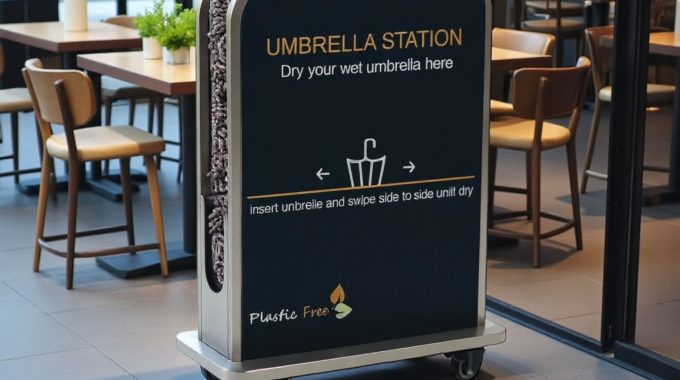
| Engineering | Full length barrier matting, drainage grates, and equipment that captures water at the door: an umbrella dryer, a bagging machine, or an umbrella stand or bin with a drip tray. |
| Administrative | Wet weather cleaning rosters, timed inspections with a signed log, and correctly placed warning signs while a floor is drying. |
| PPE | Slip resistant footwear for staff working in the wet zone, as a backup to everything above. |
The engineering row is the one that changes the arithmetic, because it removes the water before it reaches the floor rather than managing it afterwards. For a comparison of the options at that level, see our guide to wet umbrella bagging machines and umbrella dryers.
Five mistakes that keep showing up
The sign is the whole plan. A warning sign tells people a hazard exists. It does not remove the water and it does not stop anyone walking on it. Signs work as part of a system and fail as a substitute for one.
The matting is too short. A one metre mat inside the door catches the first footfall and nothing else. Industry matting guidance points to roughly six metres, about fifteen feet, of walk off matting to take the large majority of moisture off a pair of shoes, which means most Australian entrances are running a fraction of what they need.
The cleaning schedule ignores the weather. Fixed daily rosters treat a storm morning the same as a dry afternoon. A wet weather trigger, where inspection frequency increases when it starts raining, costs nothing to write and changes the outcome.
Nobody owns the entrance. When the front door belongs to facilities, the cleaning contractor, reception and the building manager all at once, it belongs to no one. Name a person per shift.
Only worker injuries get counted. If your incident register records staff only, you are blind to the visitor near misses that predict the claim. Log both.
Frequently asked questions
How many slip and fall injuries happen in Australian workplaces each year?
Falls, trips and slips of a person caused 32,000 serious workers’ compensation claims in 2023-24, or 21.8% of all serious claims, according to Safe Work Australia. Falls on the same level made up 68.3% of those.
Are wet floor signs enough to meet our duty of care?
On their own, no. A sign is an administrative control and sits near the bottom of the hierarchy of control. WHS law requires you to eliminate or minimise the risk so far as is reasonably practicable, which means addressing the water itself, the floor surface and the cleaning system as well as warning people.
What is the most effective single change at a rainy day entrance?
Stopping the water at the door. Extending barrier matting and adding equipment that captures umbrella water, instead of letting it drip through the building, removes the contaminant rather than managing it after it has spread.
Do visitors and customers count for WHS purposes?
Yes. The primary duty of care extends to other persons at the workplace, not only workers. Injuries to customers and visitors are also the usual source of public liability claims, so the commercial exposure runs on two tracks.
Where to start
Pick your next wet morning and do step one. Walk your own entrance in the rain and mark where the water goes. Almost every business that does this finds its wet zone is two to three times longer than the matting in place to handle it.
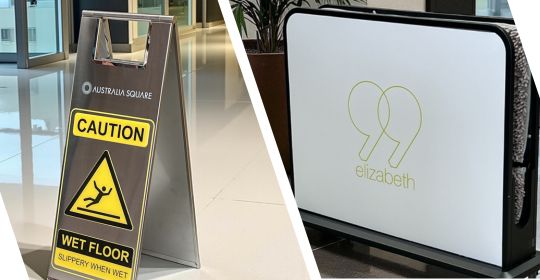
Slipless supplies the entrance side of the problem across Australia: umbrella dryers that take water off an umbrella as the visitor walks through, wet umbrella bagging machines, umbrella stands and bins with removable drip trays, and stainless steel wet floor signs for the moments when a floor genuinely is drying. If you want help sizing any of it to your entrance, get in touch.
Related Posts