
-
This product has multiple variants. The options may be chosen on the product page



Wet Floor Signs and Your Duty of Care
A wet floor sign is the cheapest safety control a facility can deploy and the one most often deployed badly. Put out late, left out after the floor dries, or placed where nobody looks, it stops being a warning and becomes background furniture. Used properly it does two things at once: it gives people time to change how they walk, and it demonstrates that a foreseeable hazard was identified and acted on.
That second point matters more than most buyers realise. Under Australian work health and safety law, a duty holder must manage risks so far as is reasonably practicable. A wet entrance is about as foreseeable as a hazard gets, because it recurs on a known trigger and concentrates in a small area. When something goes wrong, the question asked afterwards is not whether the floor was wet, but what was in place before it got wet.
Australian Standards: AS 1319 and ISO 7010
Slip warnings in Australia sit under AS 1319, the standard for safety signs in the occupational environment. It sets out how a warning sign should look so that it reads as a warning instantly, without anyone stopping to interpret it. Warning signage uses a yellow field with black symbol and border, which is why a compliant wet floor sign is yellow rather than whatever colour matches the fitout.
ISO 7010 does the same job internationally by standardising the pictogram itself, so the slipping figure means the same thing to a visitor regardless of the language they read. Buying to both keeps you consistent for local inspection and legible to international visitors, which matters in hotels, airports and universities.
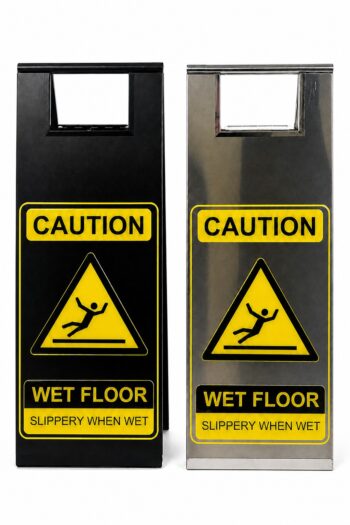
The practical test for any sign you buy: is the field yellow, is the pictogram the standard slip symbol rather than a decorative one, is the text legible at the distance people will actually see it from, and does it stay upright when someone brushes past.
Types of Wet Floor Sign
A-frame signs
The default for indoor cleaning and spill response. Foldable, visible from both directions, quick to deploy and quick to store. Best where signs go out and come back several times a day.
Cone and pyramid signs
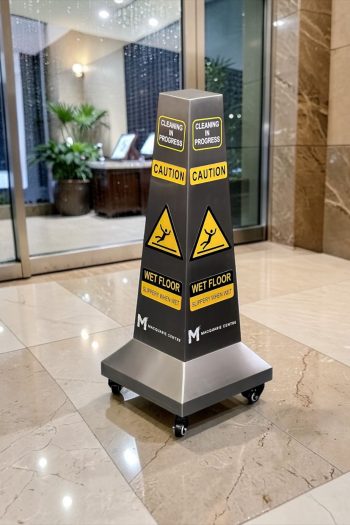
Narrower footprint and visible from every angle, which suits corridors and doorways where an A-frame would obstruct. Models on wheels can be repositioned without a staff member bending down, useful during a long clean.
Stainless steel signs
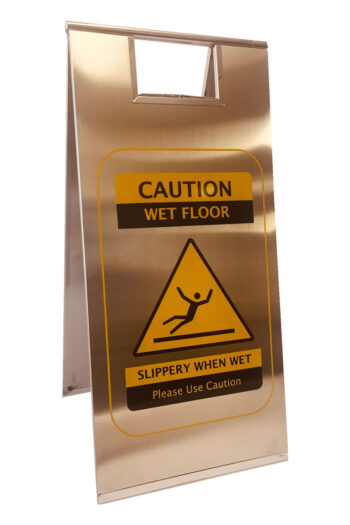
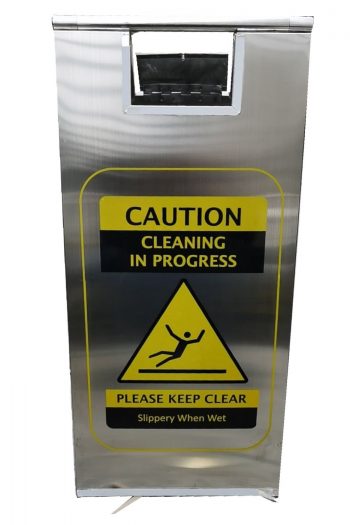
Where a sign is permanently stationed in a front-of-house area, plastic looks temporary and gets scuffed. Stainless holds its appearance in a lobby and stands up to daily handling. Worth it where the sign is on display as much as it is in use.
Custom signs
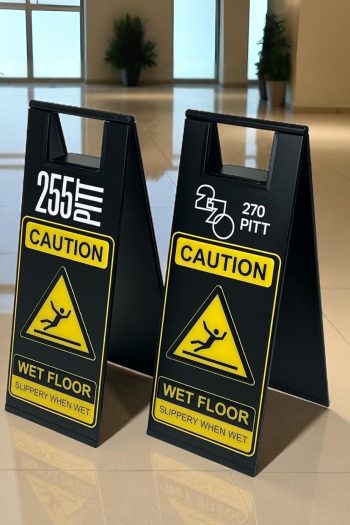
Adding your own wording or logo helps in two ways. It stops the sign reading as generic clutter, and in multilingual environments it lets you carry a second language alongside the standard pictogram.
Where and How to Place Them
Placement decides whether a sign works. A few rules that hold up in practice:
- Before the hazard, not on it. A person needs to see the warning while they still have room to adjust. A sign standing in the middle of a wet patch has already failed.
- Cover every approach. A single sign facing one direction protects one direction. Entrances, lift lobbies and corridor junctions usually need two or more.
- Match the sightline. Signs work at eye level and at walking pace. Behind a planter or around a corner is the same as absent.
- Remove them once the floor is dry. This is the most commonly broken rule. Signs left out permanently train people to ignore them, and that habit carries over to the day the floor genuinely is wet.
- Log it. Where signage forms part of a cleaning schedule, recording when signs went out and came back is what turns a habit into evidence.
Signs Are a Control, Not the Only One
Under the hierarchy of control, signage is an administrative measure. It changes behaviour but it does not remove the hazard, which puts it below engineering controls that stop the water reaching the floor in the first place.
That is the argument for treating wet entrances as a system rather than a signage problem. A wet umbrella dryer or bagging machine at the door removes or contains the water before anyone walks in with it, and an umbrella stand keeps what is left in one place. Signs then cover the residual risk, which is what they are good at, instead of carrying the whole load.
Choosing by Environment
Match the sign to where it will live rather than buying one type for the whole site:
- High-traffic retail and public buildings. Sturdy A-frames that survive being knocked, in enough quantity to cover approaches.
- Corridors and doorways. Cone or pyramid styles, so the walkway stays passable.
- Front-of-house lobbies. Stainless, where appearance is part of the job.
- Outdoors and covered entries. Weather-resistant materials and enough weight to stay upright in wind.
- Multilingual sites. Standard pictogram first, custom wording second.
Frequently Asked Questions
Are wet floor signs a legal requirement in Australia?
There is no rule that names wet floor signs specifically. What the WHS Regulations require is that risks are managed so far as is reasonably practicable. For a known, recurring slip hazard, warning signage is one of the most reasonably practicable controls available, which is why its absence is difficult to defend after an incident.
What colour should a wet floor sign be?
Yellow with a black symbol and border, following the warning-sign format in AS 1319. Yellow is read as caution without conscious thought, which is the entire point of a standardised colour.
How many signs do I need?
Enough to cover every direction of approach to the hazard. One sign at a two-way entrance leaves half your visitors unwarned. Most sites underestimate this.
How long should a sign stay out?
Until the floor is genuinely dry, and no longer. Permanently stationed signs lose their meaning, and a sign people have learned to walk past is worse than none at all because it creates a false record of control.
Do you deliver across Australia?
Yes. Slip-Less supplies wet floor signs and wet entrance equipment Australia-wide. If you are working out what a site needs, get in touch and we will size it with you.